Category: event

  • What Was A Courtier?

    What Was A Courtier?

    Info for those playing Machinations: Den of Lions

    When the houses arrive at the Villa dei Leoni in November 1501, nearly everyone through the door will be a courtier of one kind or another. The cardinal’s secretary, the physician at the bedside, the poet with a folder of verses, and the lady who carries letters between houses all belong to the same world. This post offers a short guide to that world, so you can step into it with confidence.

    The Word Itself

    A courtier was a person who attended the court of a prince, which meant a monarch, a ruler of the noble class, or another powerful figure. The court was the center of government and also the prince’s home, so political and social life were woven together. Princes often expected their most important nobles to spend much of the year in attendance.

    Courtiers were not all noble. The court also held clergy, soldiers, clerks, secretaries, and agents and middlemen of every sort with regular business there. Even if your character has no title, you may still belong at the villa as fully as anyone.

    The Great Chain of Being

    One of the strongest ideas carried over from the classical world was the Great Chain of Being. Its central premise was that everything in the universe had a place in a divinely planned order, pictured as a chain stretching upward, with each link ranked above or below the next.

    Courtiers worked to rise along that chain by attaching themselves to someone above them. Through that bond a courtier could advance, gain power and authority, grow wealthy, help raise their own family to nobility, and serve society. How to do all this well was a matter of lively debate. Three writers give us three quite different answers.

    Three Models of the Courtier

    Castiglione and the well-rounded gentleman

    Baldassare Castiglione wrote The Book of the Courtier, published in 1528. It records a conversation among courtiers of the Duke and Duchess of Urbino about what makes a good courtier, and it became the standard guide to being a Renaissance gentleman. In 1501 Castiglione was in his early twenties and had just entered the service of the Gonzaga of Mantua, so his ideal grew out of the very world you will be playing in.

    His courtier is well educated and well rounded: skilled in arms and in war, and just as able to dance, sing, and play an instrument. He also makes a point of doing all of it with ease, a quality Castiglione called sprezzatura. What sets his courtier apart from those in other books is the duty of honest counsel. A good courtier tells his lord when an act is ignoble, in order to save the lord from himself. Thomas Hoby’s English translation of 1561 puts it this way:

    “The final end of a Courtier, where to al his good condicions and honest qualities tende, is to beecome an Instructer and Teacher of his Prince or Lorde, inclininge him to vertuous practises: and to be francke and free with him, after he is once in favour in matters touching his honour and estimation, alwayes putting him in minde to folow vertue and to flee vice, opening unto him the commodities of the one and inconveniences of the other: and to shut his eares against flatterers, whiche are the first beeginninge of self leekinge and all ignorance”.  – From Hoby’s A BREEF REHERSALL OF THE CHIEFE CONDITIONS AND QUALITIES IN A COURTIER)

    Machiavelli and the practical prince

    Niccolò Machiavelli wrote The Prince in 1513, though it was not published until 1532. In 1501 he was a young secretary in the Florentine government, still a year or two from his famous meetings with Cesare Borgia. Some call him a founder of modern political science. His book concerns the behavior of the prince more than the courtier, though its methods would serve a courtier just as well. His guiding idea is that results matter, and that a ruler must sometimes be hard to keep order.

    “It is much safer to be feared than loved, because love is preserved by the link of obligation which, owing to the baseness of men, is broken at every opportunity for their advantage; but fear preserves you by a dread of punishment which never fails.” – From The Prince

    “How we live is so different from how we ought to live that he who studies what ought to be done rather than what is done will learn the way to his downfall rather than to his preservation.” – From The Prince

    Christine de Pizan and the courtier who governs

    Christine de Pizan wrote The Treasure of the City of Ladies, also called the Book of Three Virtues, in 1405. It is the earliest of the three, and a character in 1501 could well know it. Her subject is the women of courtly life in France, from the princess down to the peasant. For the upper nobility, her advice agrees closely with Castiglione’s ideal court lady.

    Her baronesses and the women who manage estates are given the same duties as men. While her husband serves the king, the baroness must defend her lands and people, dispense justice, and see to the daily affairs of the estate.

    “The man or the woman in whom resides greater virtue is the higher; neither the loftiness nor the lowliness of a person lies in the body according to the sex, but in the perfection of conduct and virtues.”  ? Christine de Pizan, The Book of the City of Ladies

    “If it were customary to send little girls to school and teach them the same subjects as are taught to boys, they would learn just as fully and would understand the subtleties of all arts and sciences.”  ? Christine de Pizan, The Book of the City of Ladies

    Bringing This to the Villa

    Castiglione gives the most detailed picture of the courtier’s skills, habits, and manners, and Hoby’s translation offers a handy list of qualities to cultivate and faults to avoid. Pizan’s work supports applying that picture equally to women and men, which is how we will use it in the game. It gives a well-rounded, well-educated figure and a blueprint for behavior that a court would accept.

    A note on timing: Castiglione’s and Machiavelli’s books were not yet written in 1501, though the ideas in them were already in the air. Pizan’s book was already a century old. Your character can hold any of these attitudes without having read a page.

    A few questions to try on your character before the weekend:

    • Whom do you serve, and what do you hope to gain from standing near them?
    • When your lord is wrong, do you say so, flatter, or stay silent?
    • Do you lean toward Castiglione’s grace, Machiavelli’s realism, or Pizan’s capable steward?
    • What is your finest accomplishment, and how would you display it without appearing to try?

    Further reading

    Each of these is available free online except where noted.

    Come ready to serve, advise, and scheme in good company. We look forward to seeing which kind of courtier you become.

    By Gigi Coulson, MS

  • COCO NOIR HISTORICAL SYMPOSIUM Virtual (Webinar)

    COCO NOIR HISTORICAL SYMPOSIUM Virtual (Webinar)

    Join Costumers of Color, a 501(c)(3) nonprofit dedicated to celebrating multicultural excellence in historical costuming, for the inaugural CoCo Noir Historical Symposium (Zoom Webinar), happening Saturday, January 31, 2026, as our official kickoff to Black History Month.

    This virtual gathering centers Black costumers, living historians, reenactors, scholars, and creatives who bring the past to life through dress, performance, and scholarship. CoCo Noir is built on a simple truth: every month is Black History Month — because Black history is American history. Event details, ticket links, and sign up links for presenters are located here.

    The symposium features three ways to participate:
    ? Attend — Experience a dynamic lineup of Tiny Talks (on Costuming & Historical Education), panels, and community conversations.
    ? Present — Share your dress history research, a historical figure you’ve studied, a costuming project you’re proud of, or upcoming events and appearances.
    ? Moderate — Volunteer as a Zoom moderator to help the program run smoothly and support our speakers.

    ? Tiny Talks & Presentations (8:30 a.m. – 6:00 p.m. PT)
    Throughout the day, presenters from across the Black costuming and history community will share 15–45 minute sessions highlighting their research, artistry, personal projects, and historical passions. Sessions may include research spotlights, costuming walkthroughs, historical figure deep dives, and promotional features for upcoming events and creative work.

    ? Community Connections
    Attendees will also have opportunities to follow presenters on social media, discover new historians and makers, and engage with a global community committed to honoring Black narratives through dress.

    Tickets are $20, which helps cover webinar hosting costs and allows Costumers of Color to pay honoraria to our presenters — because their voices, labor, and expertise deserve recognition.

    Through education, artistry, and inclusion, the CoCo Noir Historical Symposium uplifts the brilliance of Black creators across time and space.

    ? #CoCoNoir #CostumersOfColor

  • Georgian Salon Preparation Meetup

    Georgian Salon Preparation Meetup

    29 June 2025 from 2pm-6pm at the Front Room @ Bayview Corner in Langley, WA

    Costumers of Color & Friends are in full event preparation mode for our annual educational event, the Georgian Global Salon, scheduled for 4 October 2025 in Seattle.

    On 29 June 2025 we are inviting interested ones to attend a pre-Salon meetup in Langley, WA to learn more about the Georgian period in preparation for the annual event. Come enjoy learning a few historical games, practice a dance or two, and see a presentation on some fashion options for the second half of the 18th-century.  We will meet on 29 June at 2pm at the Front Room, 5603 Bayview Rd, Langley, WA 98260.

    RSVP to costumersofcolor@gmail.com

    For more information on the Georgian Global Salon event in October click here.

  • Salon at Palais Royal

    Salon at Palais Royal

    I am ecstatic about our 18th-century Chevalier event happening this October 5th! Inspired by the life of Jospeh Bologne (the Chevalier des Saint Georges) this event is titled: Salon at Palais Royal.

    Gigi, being ecstatic in Venice wearing a robe en chemise

    For those planning to attend, or who are interested in Joseph Bologne, please read on for details. The information and links below will make your event all the better, and acquaint you with the man behind the name. The two sections below cover The Event, and The Man.

    Why Palais-Royal? It is significant as the name of the palace in Paris where Joseph Bologne conducted Le Concert Olympique and also where Bologne later resided when he began his anti-slavery work as an abolitionist. Why “Salon”? Historically, salons were private social gatherings, most often hosted by women, where a mixture of guests discussed art, literature, music, philosophy, and politics. At a salon guests would mingle and talk in small groups, hearing different views from varied levels of society and encountering new and sometimes radical, ideas. There could be dancing, short acted dramas, intellectual debates, and card/ parlor games. Which is exactly what we will have.

    The Event

    Salon at Palais Royal weekend event begins on Friday, October 4 with happy hour at Cortina at 5pm, then a private dinner at Cortina in Seattle from 6pm – 8pm. The private dinner dress code is – do what you will! (Yes, you can dress historically or you can dress casual, the goal is to hang out together over drinks and food). You can buy tickets for the private dinner or make a reservation at Cortina on your own as space allows.

    On Saturday, October 5 ticket holders will meet at the Women’s University Club for the Afternoon Lectures and Demonstrations. Doors open at 12:30pm. From 1pm to 4pm attendees will be treated to a lecture on Joseph Bologne by Dr. Bianca Dang, a lecture on Louis-Julien Clarchies by Susan de Guardiola, a class on historical games by Agnes Gawne, a swordplay demonstration by Jenn Bahrs and Jason Ellis, and lastly a short dance class by Charlene Kern.

    The doors for the main event, the Salon at Palais Royal, will open for ticket holders (in attire appropriate to 1779-1799) at 6:30pm at the Women’s University Club in downtown Seattle. When you enter you’ll begin at the check in desk to receive your program. Then enjoy a glass of something refreshing, take photos with our two photographers, and socialize in the beautiful Georgian Revival atmosphere.

    At 8pm there will be a concert of Bologne’s Sonatas by classical violinist Selina Siow.

    Then from 8:30pm to 10:30pm you can enjoy dancing in the ballroom, relaxing and embroidering in the drawing room, having a portrait taken in the library, socializing and playing historical games in the Gold Room, or sampling the hors d’oeuvres in the dining room. The cash bar will be open during this time as well.

    At 10:30pm we will have a few announcements in the ballroom and say au revior. Doors close at 11pm.

    So this event can be enjoyed fully by all attendees we ask that the following courtesies be shown:

    • Refrain from wearing scented products to show regard for those with chemical sensitivities (no perfumes, please) Read more on fragrance-free events here
    • In the ballroom please keep your conversations quiet so the dancers can hear the caller give instructions
    • All dancers should wear soft-soled shoes that are secure on the foot (no mules)

    The full 18th-century dance program list, from which Salon at Palais Royal dances will be chosen, is:

    • An Adventure at Margate
    • Chevalier Rondo
    • Dover Cliffs
    • Gentlemen’s Pleasure
    • La Nouvelle Anglaise (The New English Lady)
    • Le Billet Doux (The Love Letter)
    • Madame Cordé’s Frolic
    • Miss Dolland’s Delight
    • Ruffs and Rhees
    • The Contending Parsons
    • The Cotery
    • The Spaniard

    For those interested in reviewing dance steps ahead of time, you may view the videos for The Spaniard, Madame Corde’s Frolic and The Cotery, three dances on our dance program list.

    By attending this event you are agreeing to abide by Costumers of Color policies for behavior and code of conduct outlined on this page. Consequences for policy violations as well as our grievance policy are also described on that page.

    The Man

    TL;DR is that Joseph Bologne, the Chevalier de Saint-Georges, born on the island of Guadeloupe in the West Indies, became one of the most important French Classical composers, writing numerous operas, string quartets, and sinfonias concertantes. Saint-Georges was also the greatest French violin virtuoso of his generation. Though known as “The Black Mozart,” it was his music that influenced the younger Wolfgang.

    Joseph Bologne
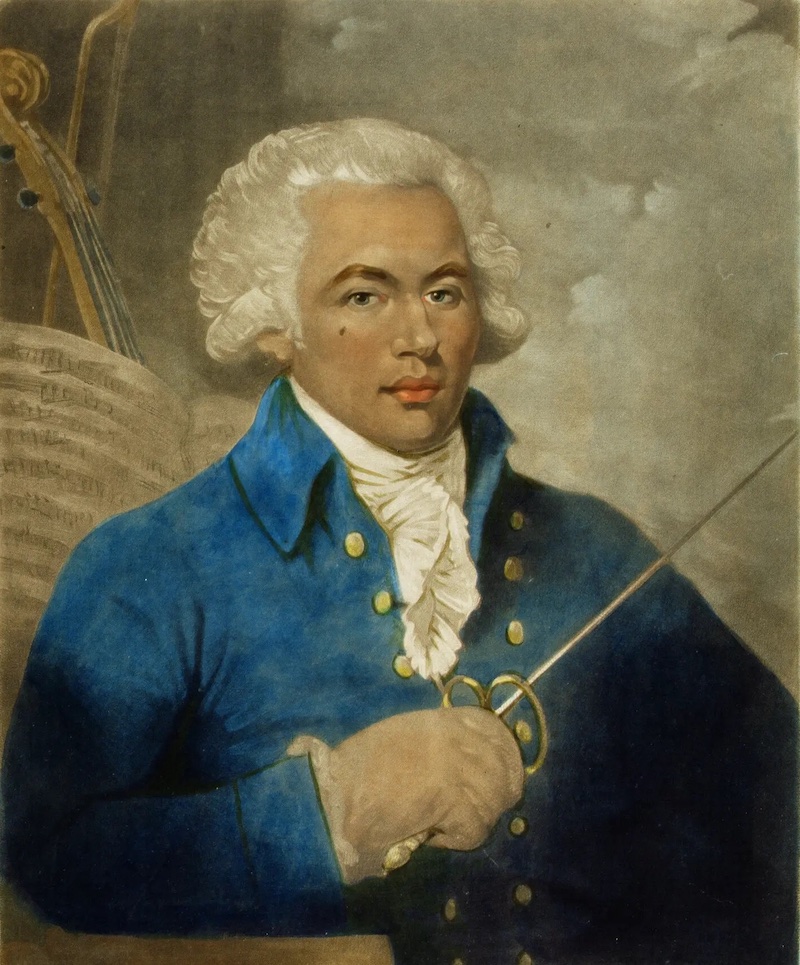
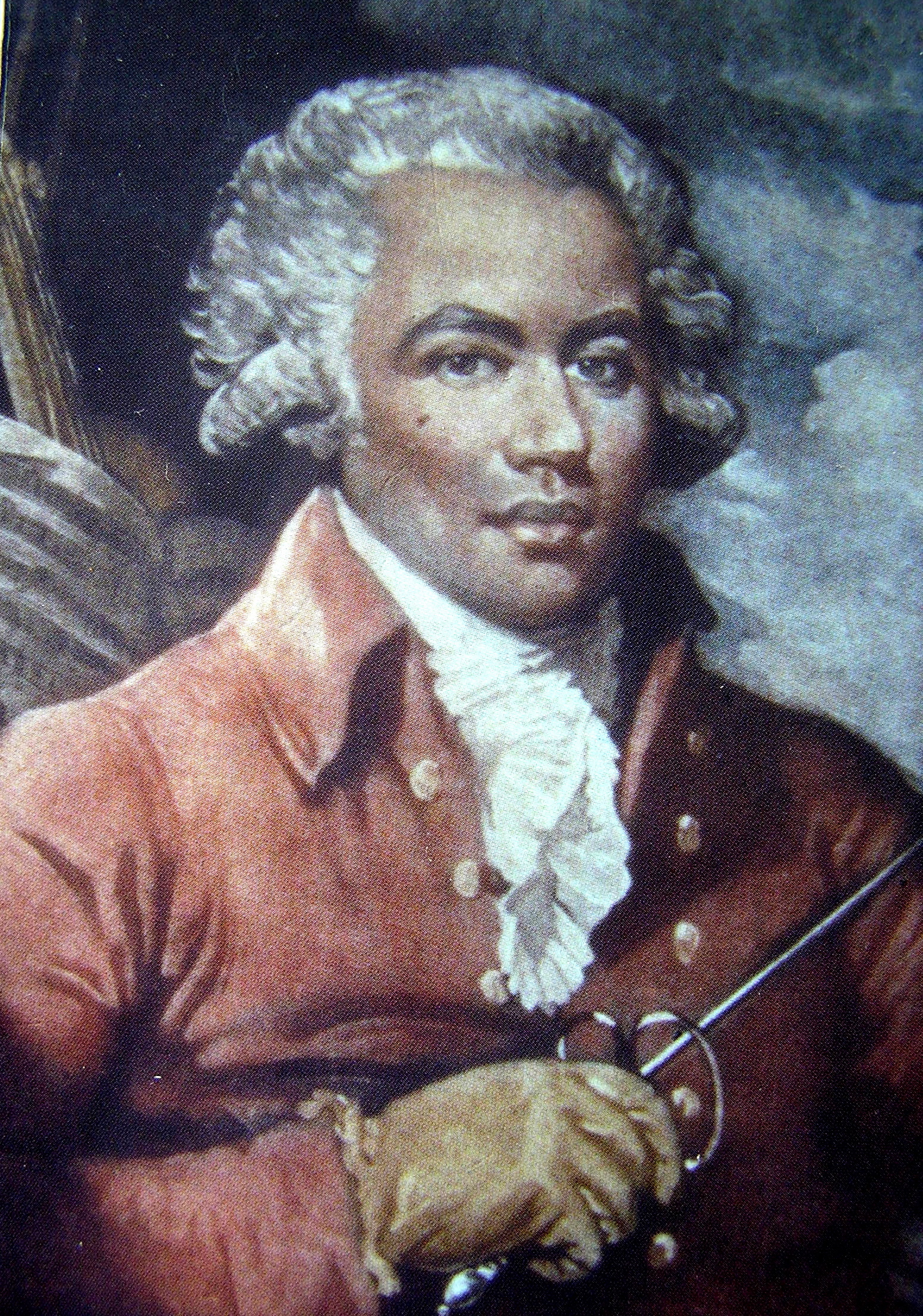
    Joseph Bologne, painted by Mather Brown circa 1788

    There are many videos on Bologne on YouTube but this one by Babatunde, the HipHopera Guy, is my favorite — Who is Joseph Bologne? There is also this documentary you can watch in addition to the Hollywood film.

    For a lovely immersion into Bologne’s music, check out this Spotify playlist curated by Cedilla Records

    Gabriel Banat’s full-length biography of Joseph Bologne (The Chevalier de Saint-Georges: Virtuoso of the Sword and the Bow) is considered to be the most definitive. You can find it in many libraries, and it includes a comprehensive list of Bologne’s compositions.

    Chevalier de Saint-Georges by Gabriel Banat

    For musicians, information about modern editions of many of Bologne’s works can be found in the directories of the Music by Black Composers project, which you can find here.

    For a longer bio of Jospeh Bologne, start here.

    Feel free to email us with any questions at gigi@costumersofcolor.org

  • Empire/ Regency Dress and Games

    Empire/ Regency Dress and Games

    Costumers of Color, Inc. hosts various costuming meetups, afternoon teas & historical game events in the PNW. Our events are for all who support the inclusion of People of Color (POC) in historical costuming and public history.

    The time period we have chosen for our afternoon tea gatherings is 1790-1815, known across Europe as Directoire, Empire, and Regency Eras* (more info on those timelines can be found in these slides). Dress inspired by the fashion of these eras is required for attendance.

    In this post you’ll find information on history, fashion, and games played during these time periods. Some of the items shown can be purchased on our CoCo storefront here.

    HISTORY

    Costumers of Color uses the following years to define the eras*: Directoire 1795-1798, Empire 1804-1815, and Regency (Late Georgian) 1811-1820. Below you’ll see modern Regency dress ideas from the GBACG (left) and from the Jane Austen Centre, UK (right). An author closely associated with these eras is Jane Austen (1775-1817). Her novels give us a glimpse into the lifestyle and society of the English aristocracy.

    This paragraph from NYPL on Empire Styles helps to understand the sociopolitical dynamics in England and France and how they are related to the names of the eras: “Two distinctive movements, now known as the Empire Style and the Regency Style, were born out of the formal Neoclassicism that dominated late eighteenth century European building and decoration. These styles were stimulated in large part by the bitter rivalry of France and England and their rulers. Napoleon I (1769-1821), self-styled Emperor of the French, chose to extend France’s imperial grandeur through force of arms. Napoleon Bonaparte came to power on the ashes of the fiery French Revolution, and distinguished himself militarily during the brief and chaotic Directoire period (1795-98). Upon assuming the throne in 1804, he immediately launched an ambitious art and design program that lasted until his reign ended in 1815. Across the English Channel, the Prince Regent, the future King George IV (1762-1830), sought ways to celebrate England’s heritage through his active patronage of the arts.”

    DRESS

    Two easy options for either a masculine or feminine presentation:

    For feminine dress, an empire waist gown is key. Regency gowns had both v-neck, scoop, and rectangular necklines. The waist was gathered right under the bosom and the skirt drops straight to the floor. They wore “stays” (like the Regency Short Stays sold by RedThreaded™) and that look can be replicated with a balconette bra that has thin, wide set straps. Empire/Regency style was meant to emulate the silhouette seen in Greek and Roman statues. Outside of Europe, the same styles can be seen, as in the images below of a woman in New Orleans circa 1805 (first) and the Royal siblings Prince Jaques-Victor, Princess Francoise-Amethiesse, and Princess Anne-Athenaire of Haiti circa 1810 (second). 

    Curly hairstyles were favored. The Jane Austen Centre advises, “A lady’s hair in the Regency period would always be up, never hanging loose. Curls were fashionable, a few tiny curls to frame the face, and the rest of the hair would be piled up on top of the head into a bun. Little embellishments such as flowers, jewelled pins or braids were popular for balls and evening activities. A few Regency hairstyle rules to follow are: Centre parting, high bun on top of the head, a few tiny curls to frame the face, and a clean bare back of the neck, this was to elongate the nape of the neck, as was considered slightly sexy in Regency times!”

    For a versatile look, part in the middle, pin up the back and curl the bangs forward or to the sides like the images of Ayana below, modeling for Stitchin’ Addiction (my favorite modiste!).

    Ayana of @thevintageguidebook for Stichin’ Addiction

    During the afternoon, a hat, bonnet, bandeau, or turban are all appropriate. 

    A small drawstring bag called a reticule was used in lieu of a purse. It’s just big enough for a phone, fan, and car keys. See the photo collage below of Angela Grimes, a GBACG member for hat, reticule, jacket, and shawl, ideas.

    Photo Credit: Angela Grimes

    Gloves (full, not fingerless), in leather or cotton (not lace), should be worn unless eating or drinking. Choose a matte finish if you are purchasing synthetic leather. You’ll remove one, or both, to drink and eat refreshments. 

    Simple jewelry consisting of necklaces, dangling earrings, brooches, and rings were worn. Peruse the Macy’s line of 2028 styles for inspirations. Pearls, gemstones, and cameos were popular. 


    What you’ll wear to the tea is considered “morning dress”, explained in this quote from Wilkes: “You’ll have to change your dress several times daily. ‘Undress’ or deshabillée is worn at home. Slightly more formal, but practical, ‘half-dress’ or ‘morning’ dress is worn for morning visits and shopping. When going to a formal occasion like a rout, assembly or ball, you’ll wear your best gown – ‘full dress’.” See the image below of the blogger at Tea In A Teacup in morning (or half) dress.

    Here are some European fashion plates and historical images depicting “morning dress” and “half dress”.

    Shoes and half-boots were worn by women along with silk stockings. America Duchess makes a line of Regency shoes inspired by actual historical models. The Jane Austen Centre advises, “Regency footwear for ladies depended on what activity they were partaking in. When attending an event that includes dancing is it always a good idea to wear comfortable flat shoes. Little pumps, ballet shoes, trainers etc. are the best things to wear. High heels are not a good idea as Regency dancing can involve quick footwork.For outside wear little heeled, lace up ankle boots are practical, especially if you’re a lady who enjoys a long walk on a fine day.”

    Women's Indoor Shoes During Regency England – Always Austen
    100 Regency Footwear (slippers, boots, stockings etc.) ideas | historical  shoes, regency fashion, shoes

    Find more dress images on our Pinterest boards for Regency https://www.pinterest.com/costumersofcolor/1800-20-empire-regency-costumers-of-color/ and 1790s https://www.pinterest.com/costumersofcolor/1790s-clothing-and-hair/. 

    Pattern links for costumers that sew can be found in the Vendors section, just scroll down. Gigi’s presenation on Regency Fashion can be downloaded here https://drive.google.com/file/d/1AiynHLllt0w_wU0sjMl9zgIB05ZN5cGq/view?usp=sharing

    GAMES

    Lottery

    “Mrs. Philips protested that they would have a nice comfortable noisy game of lottery tickets, and a little bit of hot supper afterwards. The prospect of such delights was very cheering, and they parted in mutual good spirits.” ?- ?Jane Austen, Pride & Prejudice 

    “Lydia talked incessantly of lottery tickets, of the fish she had lost and the fish she had won…”   ?- ?Jane Austen, Pride & Prejudice 

    On the continent, lottery games became popular in the 1500s and then slowly migrated to England. This basic lottery game is easy to play with large groups of people and any age. PDF game rules can be dowloaded here.

    • Materials: two decks of cards with different backs to easily differentiate them, counters for each player 
    • Number of Players: 5-40 Winning the Round: Earning counters by matching your ticket card to a prize card.
    • Winning the Round: Earning counters by matching your ticket card to a prize card.
    • Winning the Game: Having the most counters at the end of play.

    One person is designated the manager. One pack of cards is used for the tickets and one pack is used for the prizes. Two dealers are chosen in any manner. Each player puts three counters into the pot (or whatever fixed amount is determined by the manager). This forms the “lottery fund.” After shuffling and cutting the deck, Dealer One gives each player a card. This is their prize card. These cards are dealt face down. 

    Each player then takes counters from the lottery fund and places them on their prize card. The number of counters is at the discretion of the player. Dealer Two deals each player a card. This is their ticket card. The manager orders all cards to be turned over. Any player whose ticket card matches a prize card wins the counters on the prize card. This ends the round. What constitutes a match is at the discretion of the manager. The counters on any prize cards that do not have matches are returned to the lottery fund. All cards are collected, shuffled, and redealt. When all counters in the fund are used, each player will put three counters into the fund. Game play can end after a designated number of rounds or a specific amount of time or when the lottery fund is depleted. 

    For those who did not wish to play with money, they might use game counters instead. These counters could be in any shape and made of metal, wood, ivory, or even mother-of-pearl. In this case, the counters were probably shaped like fish, which was a common shape. Those who played regularly would have their own counters and often a bag or box designed specifically to carry them (Monroe). Download our rules handout here.

    Gaming Counters - Sharon Lathan, Novelist
    Game Counters

    Speculation

    ‘What shall I do, Sir Thomas? [asks his wife]: Whist and speculation; which will amuse me most?’. Sir Thomas, after a moment’s thought, recommended speculation. He was a whist player himself, and perhaps might feel that it would not much amuse him to have her for a partner. — Jane Austen, Mansfield Park

    • Materials: one deck of cards, equal number of chips for each player. 
    • Number of Players: 3-10.
    • Winning the Game: Be in possession of the highest trump when all cards in play have been exposed. For this purpose cards rank from high to low AKQJ1098765432.
    • Ending the Game: The game ends when all cards have been revealed, or when somebody turns the Ace, and whoever has the highest trump wins the pot.

    Our PDF game rules can be dowloaded here. According to Partlett everyone starts with the same number of chips and at the start of each deal antes one to a pot. Deal three cards face down on the table in front of each player in a stack, then turn the next card of the pack to establish a trump suit. (Not that there is any trick-play. Trump, in this game, means the only suit that counts for winning.)

    The object of the game is to have the highest trump card, with the deuce being the lowest card and the Ace the highest. The trump turn-up belongs by right to the dealer, so if it is an Ace the dealer wins without further play. If it is not an Ace, but is high enough to interest anyone else, they may offer to buy it from the dealer, and the dealer may haggle about it, or auction it, or keep it, as preferred.

    A box for playing-cards, c. 1791-1800

    Each in turn, starting with the player to the dealer’s left – or, if the turn-up was sold, to the purchaser’s left – turns up the top card of his or her own stack. This continues in rotation, but omitting the player who currently possesses the highest trump. If and when a trump is turned that is higher than the one previously showing, the player who turned it may offer it for sale at any mutually agreeable price, or refuse to sell it. Either way, play continues from the left of, and subsequently omitting, the possessor of the highest trump.

    Furthermore, anyone at any time may offer to buy not necessarily the best visible trump, but any face-down card or cards belonging to another player. The purchaser may not look at their faces, but must place them face down at the bottom of his or her stack and turn them up in the normal course of play. The time to indulge in this piece of speculation is when you currently own the highest trump and want to prevent someone else from turning a higher. (Partlett)

    (From Agnes Gawne of JASNA Puget Sound): The hand ends when all the cards have been turned over, and the person who has the highest trump card showing wins the hand. As with all games involving chips, the game is over when people begin to run out of chips. Download our rules handout here.

    LINKS

    RECOMMENDED VENDORS

    SOURCES & FURTHER INFO

    READY TO WEAR

    …

  • Schedule of Events for Inclusive Costumers 2024-2025

    Schedule of Events for Inclusive Costumers 2024-2025

    Dear Gentle Readers, the next year will be filled with events for anti-racist costumers who support inclusion in the community to gather, swan about being fabulous, and have a swimmingly good time, all brought to you by Costumers of Color 501(c)(3) nonprofit organization. 

    ? First up on June 8, 2024 is our Regency Tea in Seattle, WA at the swanky Fairmont Olympic that will be giving Sense & Sensibility ?????! Join Lady Coulson to enjoy tea, drinks, lunch, brunch, and desserts in a beautiful, relaxing environment. 

    ?? On August 3, 2024 I’m holding a 1790-1805 Empire card party and afternoon tea at My Cup of Tea in Burlington, WA from 12pm-3pm for those who want to meetup and learn few games. Please fill out this form if you’d like to attend https://forms.gle/es8qSisBtych8Ybm6. More information on RegencyEra /Empire Era dress and games here.

    On August 24, 2024 and September 21st we are hosting a sewing meetup at the Bellevue Branch Library from 11am-1pm for those who want to compare patterns, help each other with measurements, and cut/ sew pattern pieces together.

    ? Next on October 4 – 5, 2024 in Seattle WA there will be an #18thCentury weekend event inspired by the fabulous Chevalier de Saint-Georges, Joseph Bologne. 

    ? In 2025 we head to Venice again from February 26-March 7 for a week of costuming in La Serenissima.

    ?An Edwardian Retreat in an historical mansion in Seattle, WA for BIPOC costumers (only) is scheduled for April 24-27, 2025.

    ?From June 11-16, 2025 we will travel to Bath, UK to stay in a Georgian Townhouse for a week of Regency inspired shenanigans and, of course, taking the waters. 

    ? Subscribe for updates on inclusive costuming events, trips, and highlights of costumers of color around the world!


  • Joseph Bologne: Chevalier de Saint-Georges

    Joseph Bologne: Chevalier de Saint-Georges

    The following is a repository of pertinent information I’ve found on Joseph Bologne that may be of interest to my subscribers, especially since there will be an event inspired by the legend of the Chevalier de Saint-Georges in October of 2024. I compiled this post because, in the words of the writer of the recent film:

    “How were all of his accomplishments—master equestrian, master fencer, master violinist, master composer, leading an all-Black regimen during the French Revolution, hanging out in Versailles with Marie Antoinette—real?”

    Stefani Robinson

    Joseph Bologne, the Chevalier de Saint-Georges, was an extraordinarily accomplished man in the France of Marie Antoinette’s time. He was a scholar, a fencer, a virtuoso violinist and a famous and sought-after composer who wrote string quartets, symphonies and operas. His influence was significant, but erased from history books because Bologne was also Black, born in 1745 in the French colony of Guadeloupe to a French plantation owner, the married Georges de Bologne Saint-Georges, and an enslaved Senegalese teenager called Nanon. Bologne is considered the first composer of color to achieve prominence in the European classical scene.

    At the height of his celebrity and renown in France, Bologne put his name forth to lead the Royal Academy of Music at the Paris Opera. Though qualified for the prestigious post, his appointment was blocked.

    He had powerful friends, made a Gendarme du roi of King Louis XVI in Versailles and a chevalier (knight), securing a place as a musician in the court of Marie Antoinette, and earning the admiration of US President John Adams, who once called him “the most accomplished man in Europe.” 

    And yet, history better remembers his White contemporaries.

    Bologne’s birth to a noble father shielded him from some — but not all — of the prejudice of his time. Slavery was legal in France until 1794, and “Le Code Noir,” an edict governing virtually every part of an enslaved person’s life, also engendered the discrimination of free people of color. Three years after Bologne’s death in 1799, Napoleon Bonaparte reestablished slavery in France and many of Joseph Bologne’s works were destroyed.

    Bologne was known during his time even across the Atlantic Ocean by our founding fathers.

    [Arthur] Lee gave Us an Account of St. George at Paris, a Molatto Man, Son of a former Governor of Guadaloupe, by a Negro Woman. He has a sister married to a Farmer General. He is the most accomplished Man in Europe in Riding, Running, Shooting, Fencing, Dancing, Musick. He will hit the Button, any Button on the Coat or Waistcoat of the greatest Masters. He will hit a Crown Piece in the Air with a Pistoll Ball.

    John Adams – written on 17 May 1779 in his diary (with some errors, as Bologne wasn’t a governor’s son)

    Arthur Lee, who raved to John Adams about Bologne, was a physician and opponent of slavery in colonial Virginia in North America who served as an American diplomat who helped negotiate and signed the 1778 Treaty of Alliance with France.

    A 1787 print of Chevalier de Saint-Georges. 'Chevalier' is a title akin to a knight, and Bologne earned the moniker after finishing his fencing studies.
    A 1787 print of Chevalier de Saint-Georges. ‘Chevalier’ is a title equivalent to knight, and Bologne earned that title from the King of France for being an expert swordsman. Credit: SPCollection/Alamy Stock Photo

    Bologne was a man of firsts: the first Black conductor of Paris’ renowned orchestra Le Concert Olympique, and among the first Black men to lead a regiment in the French army.

    Chevalier de Saint-Georges wielded the foil, the bow and made music with equal skill. He also served as a colonel of the Légion St.-Georges, the first all-Black regiment in Europe (during the French Revolution). In 2023, his life is being portrayed on the movie screen and the world is rediscovering this champion sword fighter, a virtuoso musician, and a conductor of the leading symphony orchestra in 18th-Century Paris.

    Joseph Bologne, as played by actor Kelvin Harrison, Jr. Credit: Larry Horricks/20th Century Studios

    Classical music has a long and detailed history, which regularly includes works by some of the greatest composers ever to have lived, from Bach to Beethoven, Mozart to Mahler. There are many great composers, however, who are unfairly left out of the history books despite their valuable and important contributions to classical music. Now, we are finally learning about Joseph Bologne, Chevalier de Saint-Georges (1745-1799).

    Chevalier de Saint-Georges - Wikipedia
    Saint-Georges, posing with his fencing foil, by Mather Brown, 1787. Wikimedia Commons

    Bologne is also one of the 40 composers featured in The RBP Foundation Coloring Book of Black Composers. Here is his drawing and bio from the book (click here to download the PDF).

    TIMELINE

    • 1712-1830 – Georgian Era: Georges reigned in Great Britain during this timeframe. English term used most commonly to refer to a style of eighteenth century architecture, clothing, and as a synonym for “18th C British”.
    • 1745 – Joseph Bologne born in Baillif, Guadeloupe on Dec 25
    • 1770 – Bologne’s first documented compositions
    • 1773 – Bologne becomes director of Le Concert des Amateurs.
    • 1776 – Proposal to appoint Bologne as director of Paris Opera blocked
    • 1785 – Philippe, duc d’Orléans becomes Bologne’s patron
    • 1787 to 1789 – Bologne works to bring the abolitionist movement to France
    • 1789 – French Revolution begins
    • 1794 – Abolition of slavery throughout all territories of the French Republic
    • 1795-1799 – Directoire Era: French term for this period, especially in France (which was ruled by a directorate of five, and then three, men).
    • 1799 – Joseph Bologne dies in Paris

    FALL 2024 EVENT

    Costumers of Color is inviting BIPOC and anti-racists to come to Seattle and party like it’s 1799! This weekend event is your chance pay homage and celebrate the excellence/ resilience of people of color (POC) from the past while participating in 18th-century activities and wearing Georgian/Directoire clothing. The weekend will be filled with informative demonstrations, lectures, delicious food, historical games, Joseph Bologne’s music, dancing, and lively conversation. All attempts and interpretations of 18th Century costume are welcome, from exacting historically plausible dress to inspired afro-futurist designs!

    • Friday – Dinner (6pm-9pm)
    • Saturday – Afternoon Lectures & Demonstrations (1-3pm)
    • Saturday – Evening Salon (7-11pm)

    More information coming soon. All event info will be posted on this page. If you are interested in attending please fill out this INTEREST FORM so we can collect preferences and needs information to plan the most inclusive event possible.

    SOURCES

    Banat, Gabriel. The Chevalier de Saint-Georges: Virtuoso of the Sword and the Bow. (2006)

    Bardin, Pierre. Joseph de Saint-George, Le Chevalier Noir. (2006)

    Barton Pine, Rachel. “The Real History and Works of Joseph Bologne, the Chevalier de Saint-Georges. From https://www.violinist.com/blog/RachelBartonPine/20235/29619/

    Black Girl Nerds https://blackgirlnerds.com/chevalier-de-saint-georges-the-real-black-mozart-is-adapted-into-a-motion-picture/

    BBC https://www.bbc.co.uk/programmes/b05wdsnl

    BBC https://www.bbc.co.uk/teach/ten-pieces/KS2-joseph-bologne-chevalier-de-saint-georges-symphony-no-1-in-g-major-allegro/zrpsv9q

    Chevalier Playlist of Joseph Bologne’s music on Spotify at https://open.spotify.com/playlist/31aJDs8TUiexIr82jfpVEI?go=1&sp_cid=845bf18d7b3359ca3c48f2054fa34027&utm_source=embed_player_p&utm_medium=desktop

    CNN https://www.cnn.com/style/article/chevalier-movie-joseph-bologne-composer-true-story-cec/index.html

    Costumers of Color YouTube Playlist for Jospeh Bologne at https://youtube.com/playlist?list=PL5BZKac6z6r_YIPLDOnbrA29fg9LkYq-9&si=oZ6zf5HWnV4tRbyB

    Dirty, Sexy History https://dirtysexyhistory.com/2018/12/19/composer-abolitionist-hero-the-extraordinary-life-of-the-chevalier-de-saint-georges/

    Duchen, Jessica. The Chevalier de Saint-Georges: The Man Who Got Under Mozart’s Skin. The Independent, February 7th, 2016.

    Garnier-Panafieu, Michelle. Le Chevalier de Saint-Georges. AfriClassical.com, January 1st, 2016

    ICAN https://icanradio.org/blog/five-black-composers-who-changed-history/

    Oxford Philharmonic Orchestra https://oxphilorchestrablog.com/2020/10/09/sancho-saint-georges/

    SHARE

    This post is self-supported, self-published, and free to the public, so please share it if you enjoyed it.

  • Lady Charbonnet’s Society Papers #3

    Lady Charbonnet’s Society Papers #3

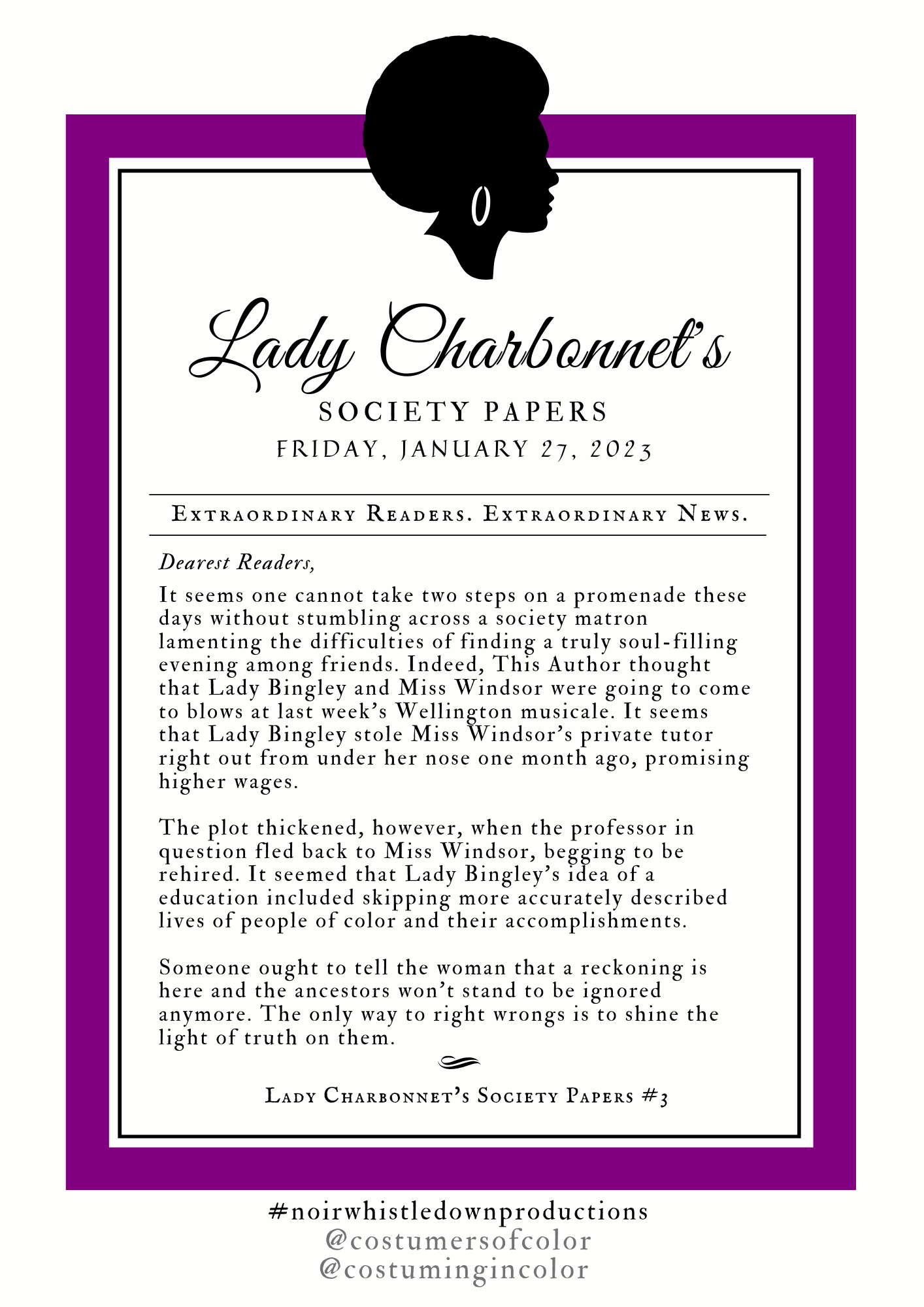
    LADY CHARBONNET’S SOCIETY PAPERS

    FRIDAY, JAN 27, 2023

    Extraordinary Readers. Extraordinary News.

    Dearest Readers,

    It seems one cannot take two steps on a promenade these days without stumbling across a society matron lamenting the difficulties of finding a truly soul-filling evening among friends. Indeed, This Author thought that Lady Bingley and Miss Windsor were going to come to blows at last week’s Wellington musicale. It seems that Lady Bingley stole Miss Windsor’s private tutor right out from under her nose one month ago, promising higher wages.

    The plot thickened, however, when the professor in question fled back to Miss Windsor, begging to be rehired. It seemed that Lady Bingley’s idea of a education included skipping more accurately described lives of people of color and their accomplishments.

    Someone ought to tell the woman that a reckoning is here and the ancestors won’t stand to be ignored anymore. The only way to right wrongs is to shine the light of truth on them.

    ~

    Lady Charbonnet’s Society Papers #3 – Click below to download your personal copy!

    #silkroutes2023

    @costumersofcolor

  • Lady Charbonnet’s Society Papers #2

    Lady Charbonnet’s Society Papers #2

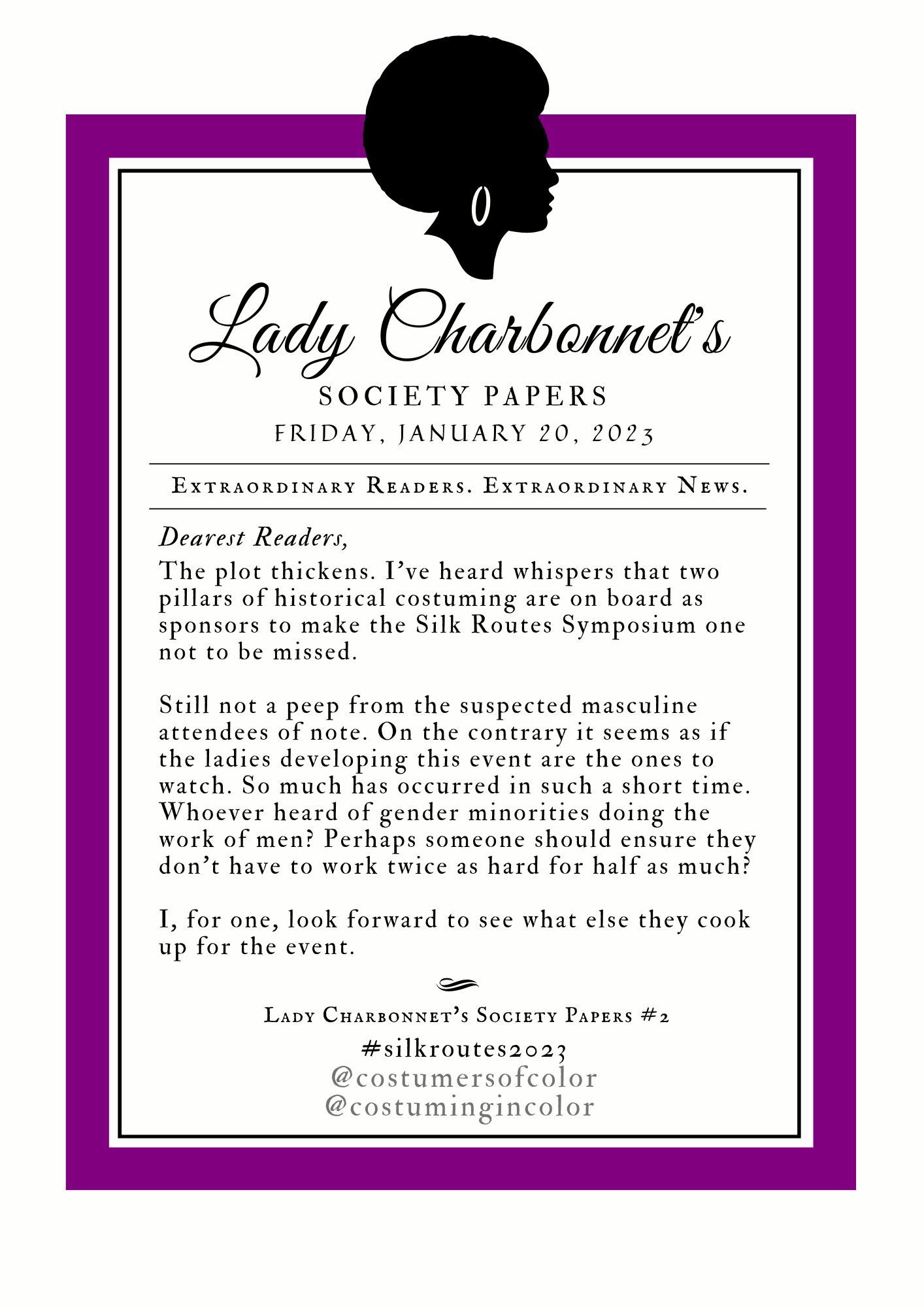
    LADY CHARBONNET’S SOCIETY PAPERS

    FRIDAY, JAN 20, 2023

    Extraordinary Readers. Extraordinary News.

    Dearest Readers,

    The plot thickens. I’ve heard whispers that two pillars of historical costuming are on board as sponsors to make the Silk Routes Symposium one not to be missed.

    Still not a peep from the suspected bachelor attendees of note. On the contrary it seems as if the ladies developing this event are the ones to watch. So much has occurred in such a short time. Whoever heard of gender minorities doing the work of men? Perhaps someone should ensure they don’t have to work twice as hard for half as much?

    I, for one, look forward to see what else they cook up for the event.

    ~

    Lady Charbonnet’s Society Papers #2 – Click below to download your personal copy!

    #silkroutes2023

    @costumersofcolor

  • Classes & Panels

    Classes & Panels

    For #SilkRoutes2023 we have 10 classes and 3 panels lined up so far!

    Tune in to our YouTube channel on February 5 to learn about Silk Routes cultures, fashion, cosplay connections, and beauty from this amazing list of instructors.

    The class schedule and links for the event will be posted on the List of Classes page (click here).