
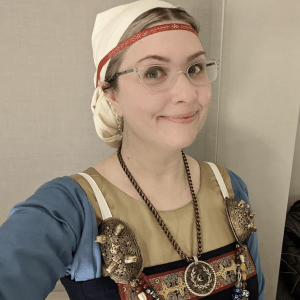
Kerry (she/they) is a historical reenactor who focuses primarily on Norse (Viking Era) silk textile finds and trade, silk brocade tablet weaving, and Birka-area research topics. She is particularly interested in how fashion and textiles from the far east were incorporated in Norse culture as luxury goods. Kerry’s day job involves medical-related research and article drafting, and she enjoys spending time with her husband David and two cats, Kolr and Jet.
Where to find me:
Kerry’s class is titled “The Silk Road of the North”:
The Silk Road was an intricate mix of land and ocean route connecting Asia (East) to Europe (West) from 200 BCE to 1700 CE, originating in eastern China near the coast and extending to Constantinople. However, there is a wealth of evidence that suggests silk traveled to Western Europe, Scandinavia, and beyond. This evidence comes in the forms of unearthed trade goods and coins from the Byzantine Empire and Abbasid Caliphate, and documented eyewitness accounts noting the travel of silk through Khazaria and Rus lands destined for a thriving Norse (Swedish) trade center known as Birka. This activity, which spanned the 8th, 9th, and 10th centuries, has prompted scholars to label this trade route to Birka the Silk Road of the North.
This class shall review Birka’s history and significance, including when and why it was established. It will also discuss the town’s layout, the people who lived there, and why it was an ideal location for trade. Silk textile finds from Birka shall be examined and discussed by type, and unearthed archeological evidence will support how silk was an imported trade good with origins further south and east. Other trade-related extant objects, such as coins and burial finds, are included to confirm which trade partners were involved in the Silk Road of the North. Eyewitness accounts and evidence along possible routes will document how silk may have moved from production centers to Birka. Moreover, this report will address why Birka, as a trade hub, only survived 250-300 years and what may have led to its abandonment.
 Costumers of Color