

Costumers of Color, Inc. hosts various costuming meetups, afternoon teas & historical game events in the PNW. Our events are for all who support the inclusion of People of Color (POC) in historical costuming and public history.
The time period we have chosen for our afternoon tea gatherings is 1790-1815, known across Europe as Directoire, Empire, and Regency Eras*. Dress inspired by the fashion of these eras is required for attendance. The scheduled teas are listed here. Please fill out this form if you’d like to attend https://forms.gle/es8qSisBtych8Ybm6.
In this post you’ll find information on history, fashion, and games played during these time periods.
HISTORY
Costumers of Color uses the following years to define the eras*: Directoire 1795-1798, Empire 1804-1815, and Regency (Late Georgian) 1811-1820. Below you’ll see modern Regency dress ideas from the GBACG (left) and from the Jane Austen Centre, UK (right). An author closely associated with these eras is Jane Austen (1775-1817). Her novels give us a glimpse into the lifestyle and society of the English aristocracy.


This paragraph from NYPL on Empire Styles helps to understand the sociopolitical dynamics in England and France and how they are related to the names of the eras: “Two distinctive movements, now known as the Empire Style and the Regency Style, were born out of the formal Neoclassicism that dominated late eighteenth century European building and decoration. These styles were stimulated in large part by the bitter rivalry of France and England and their rulers. Napoleon I (1769-1821), self-styled Emperor of the French, chose to extend France’s imperial grandeur through force of arms. Napoleon Bonaparte came to power on the ashes of the fiery French Revolution, and distinguished himself militarily during the brief and chaotic Directoire period (1795-98). Upon assuming the throne in 1804, he immediately launched an ambitious art and design program that lasted until his reign ended in 1815. Across the English Channel, the Prince Regent, the future King George IV (1762-1830), sought ways to celebrate England’s heritage through his active patronage of the arts.”
DRESS
For our teas you’ll need either:
- a suit (use this guide from the Jane Austen Centre for inspiration) or,
- an empire waist dress, shoes (ballet flat style), gloves, and hair pinned up then (optionally) covered with a turban or bonnet (for more info see Angela Grimes’ GBACG wardrobe primer or the Jane Austen Centre’s webpage on clothing)
For feminine dress, you’ll need an empire waist gown. Their gowns had both v-neck, scoop, and rectangular necklines. The waist is gathered right under the bosom and the skirt drops straight to the floor. They wore “stays” like the Regency Short Stays sold by RedThreaded™, and that look can be replicated with a balconette bra that has thin, wide set straps. Empire/Regency style was meant to emulate the silhouette they saw in Greek and Roman statues. See images below of a woman in New Orleans circa 1805 (first) and the Royal siblings Prince Jaques-Victor, Princess Francoise-Amethiesse, and Princess Anne-Athenaire of Haiti circa 1810 (second).


Curly hairstyles were favored. The Jane Austen Centre advises, “A lady’s hair in the Regency period would always be up, never hanging loose. Curls were fashionable, a few tiny curls to frame the face, and the rest of the hair would be piled up on top of the head into a bun. Little embellishments such as flowers, jewelled pins or braids were popular for balls and evening activities. A few Regency hairstyle rules to follow are: Centre parting, high bun on top of the head, a few tiny curls to frame the face, and a clean bare back of the neck, this was to elongate the nape of the neck, as was considered slightly sexy in Regency times!”
For a versatile look, part in the middle, pin up the back and curl the bangs forward or to the sides like the images of Ayana below, modeling for Stitchin’ Addiction (my favorite modiste!).

During the afternoon, a hat, bonnet, bandeau, or turban are all appropriate.
A small drawstring bag called a reticule was used in lieu of a purse. It’s just big enough for a phone, fan, and car keys. See the photo collage below of Angela Grimes, a GBACG member for hat, reticule, jacket, and shawl, ideas.

Gloves (full, not fingerless), in leather or cotton (not lace), should be worn. Choose a matte finish if you are purchasing synthetic leather. You’ll remove one, or both to eat your refreshments.
Simple jewelry consisting of necklaces, dangling earrings, brooches, and rings were worn. Peruse the Macy’s line of 2028 styles for inspirations. Pearls, gemstones, and cameos were popular.

What you’ll wear to the tea is considered “morning dress”, explained in this quote from Wilkes: “You’ll have to change your dress several times daily. ‘Undress’ or deshabillée is worn at home. Slightly more formal, but practical, ‘half-dress’ or ‘morning’ dress is worn for morning visits and shopping. When going to a formal occasion like a rout, assembly or ball, you’ll wear your best gown – ‘full dress’.” See the image below of the blogger at Tea In A Teacup in morning (or half) dress.

Here are some European fashion plates and historical images depicting “morning dress”.

Shoes and half-boots were worn by women along with silk stockings. America Duchess makes a line of Regency shoes inspired by actual historical models. The Jane Austen Centre advises, “Regency footwear for ladies depended on what activity they were partaking in. When attending an event that includes dancing is it always a good idea to wear comfortable flat shoes. Little pumps, ballet shoes, trainers etc. are the best things to wear. High heels are not a good idea as Regency dancing can involve quick footwork.For outside wear little heeled, lace up ankle boots are practical, especially if you’re a lady who enjoys a long walk on a fine day.”


Find more dress images on our Pinterest boards for Regency https://www.pinterest.com/costumersofcolor/1800-20-empire-regency-costumers-of-color/ and 1790s https://www.pinterest.com/costumersofcolor/1790s-clothing-and-hair/.
Pattern links for costumers that sew can be found in the Vendors section, just scroll down.
GAMES
Lottery
“Mrs. Philips protested that they would have a nice comfortable noisy game of lottery tickets, and a little bit of hot supper afterwards. The prospect of such delights was very cheering, and they parted in mutual good spirits.” - Jane Austen, Pride & Prejudice
“Lydia talked incessantly of lottery tickets, of the fish she had lost and the fish she had won…” - Jane Austen, Pride & Prejudice
On the continent, lottery games became popular in the 1500s and then slowly migrated to England. This basic lottery game is easy to play with large groups of people and any age.
- Materials: two decks of cards with different backs to easily differentiate them, counters for each player
- Number of Players: 5-40 Winning the Round: Earning counters by matching your ticket card to a prize card.
- Winning the Round: Earning counters by matching your ticket card to a prize card.
- Winning the Game: Having the most counters at the end of play.
One person is designated the manager. One pack of cards is used for the tickets and one pack is used for the prizes. Two dealers are chosen in any manner. Each player puts three counters into the pot (or whatever fixed amount is determined by the manager). This forms the “lottery fund.” After shuffling and cutting the deck, Dealer One gives each player a card. This is their prize card. These cards are dealt face down.
Each player then takes counters from the lottery fund and places them on their prize card. The number of counters is at the discretion of the player. Dealer Two deals each player a card. This is their ticket card. The manager orders all cards to be turned over. Any player whose ticket card matches a prize card wins the counters on the prize card. This ends the round. What constitutes a match is at the discretion of the manager. The counters on any prize cards that do not have matches are returned to the lottery fund. All cards are collected, shuffled, and redealt. When all counters in the fund are used, each player will put three counters into the fund. Game play can end after a designated number of rounds or a specific amount of time or when the lottery fund is depleted.
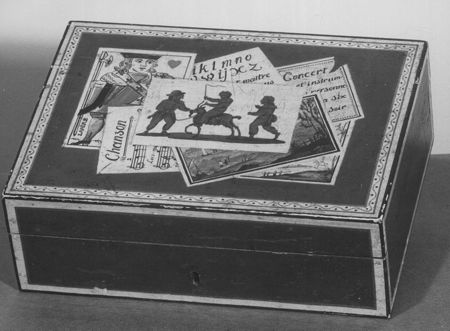
For those who did not wish to play with money, they might use game counters instead. These counters could be in any shape and made of metal, wood, ivory, or even mother-of-pearl. In this case, the counters were probably shaped like fish, which was a common shape. Those who played regularly would have their own counters and often a bag or box designed specifically to carry them (Monroe).

Speculation
‘What shall I do, Sir Thomas? [asks his wife]: Whist and speculation; which will amuse me most?’. Sir Thomas, after a moment’s thought, recommended speculation. He was a whist player himself, and perhaps might feel that it would not much amuse him to have her for a partner. — Jane Austen, Mansfield Park
- Materials: one deck of cards, equal number of chips for each player.
- Number of Players: 3-10.
- Winning the Game: Be in possession of the highest trump when all cards in play have been exposed. For this purpose cards rank from high to low AKQJ1098765432.
- Ending the Game: The game ends when all cards have been revealed, or when somebody turns the Ace, and whoever has the highest trump wins the pot.
According to Partlett everyone starts with the same number of chips and at the start of each deal antes one to a pot. Deal three cards face down on the table in front of each player in a stack, then turn the next card of the pack to establish a trump suit. (Not that there is any trick-play. Trump, in this game, means the only suit that counts for winning.)
The object of the game is to have the highest trump card, with the deuce being the lowest card and the Ace the highest. The trump turn-up belongs by right to the dealer, so if it is an Ace the dealer wins without further play. If it is not an Ace, but is high enough to interest anyone else, they may offer to buy it from the dealer, and the dealer may haggle about it, or auction it, or keep it, as preferred.
Each in turn, starting with the player to the dealer’s left – or, if the turn-up was sold, to the purchaser’s left – turns up the top card of his or her own stack. This continues in rotation, but omitting the player who currently possesses the highest trump. If and when a trump is turned that is higher than the one previously showing, the player who turned it may offer it for sale at any mutually agreeable price, or refuse to sell it. Either way, play continues from the left of, and subsequently omitting, the possessor of the highest trump.
Furthermore, anyone at any time may offer to buy not necessarily the best visible trump, but any face-down card or cards belonging to another player. The purchaser may not look at their faces, but must place them face down at the bottom of his or her stack and turn them up in the normal course of play. The time to indulge in this piece of speculation is when you currently own the highest trump and want to prevent someone else from turning a higher. (Partlett)
(From Agnes Gawne of JASNA Puget Sound): The hand ends when all the cards have been turned over, and the person who has the highest trump card showing wins the hand. As with all games involving chips, the game is over when people begin to run out of chips.
AMAZON LINKS
Dresses & Accessories from Amazon:
- https://amzn.to/4dfNQwb – Nuoqi Floral Regency Era Dresses (my favorite)
- https://amzn.to/3zEfjJe – Tea Party Dress
- https://amzn.to/3xX3KMO – Puff Sleeve Regency Dress
- https://amzn.to/3LnYFQL – Regency Spencer Jacket (my favorite)
- https://amzn.to/3zRxlHS – Regency Spencer Jacket (the sleeves run short)
- https://amzn.to/4cEaeiD – Ballet Flats
- https://amzn.to/4eYZjlj – Cotton Fan
- https://amzn.to/3WmqCii (white) https://amzn.to/3zHTwAv (black) – Cotton Gloves
VENDORS
- American Duchess for shoes
- Laughing Moon Patterns for dresses, undergarments, caps, and jackets
- RedThreaded for stays
- Stitchin’ Addiction for bespoke dresses
SOURCES
- GBACG. “Regency Capsule Wardrope Tips” by Angela Grimes. Accessed on July 13 at https://gbacg.org/finery/regency-capsule-wardrobe-tips/
- GBACG. “No Sew Regency Challenge”. Accessed on July 13 at https://gbacg.org/finery/50-no-sew-regency-era-challenge/
- Jane Austen Centre UK. “Regency Clothing”. Accessed on July 13 at https://janeausten.co.uk/pages/festival-regency-clothing
- Monroe, Holli Jo. The Proper Guide to Parlor Games (The Regency Reference Series). Brillig Press. Kindle Edition.
- NYPL Empire and Recency Styles. Accessed on July 13, 2024 at https://www.nypl.org/node/5649?fbclid=IwAR1k6A0wCAtffHwliK-arkrp0KpVI0Ua-LA-7qPcad-PSwj9hHVB6DvS-5I
- Partlett Games: Speculation. Accessed on July 13 2024 at https://www.parlettgames.uk/histocs/speculat.html
- Pinterest – Regency https://www.pinterest.com/costumersofcolor/1800-20-empire-regency-costumers-of-color/
- Pinterest – 1790s https://www.pinterest.com/costumersofcolor/1790s-clothing-and-hair/.
- Stitchin’ Addiction. https://stitchinaddictionshop.com/products/miss-lambes-wardrobe-1800-1815
- Tea In A Teacup https://teainateacup.wordpress.com/tag/regency-ball-gown/
- Wilkes, Sue. A Visitor’s Guide to Jane Austen’s England (p. 64). Pen & Sword Books. Kindle Edition..
…
 Costumers of Color